Did AGI arrive? Maybe but it wasn't just because of Astra..
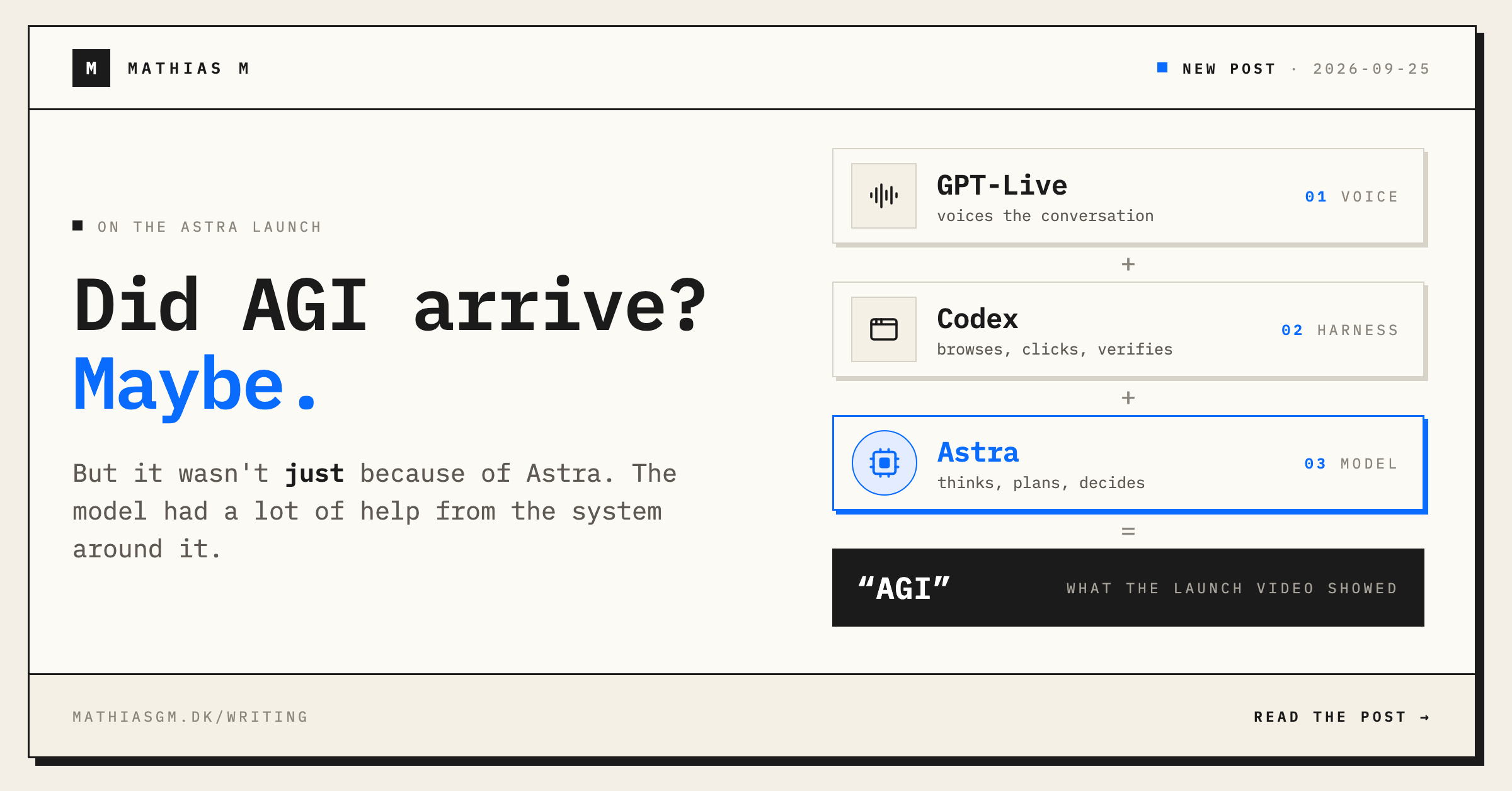
This blogpost is about understanding the release of Astra and the potential claims about the arrival of AGI.
Astra was launched on the 3rd of September 2026. It arrived with quite a splash. SOTA on many benchmarks and a remarkable 99.9% on the ARC-AGI-3 test. The hype was pushed even further when Greg Brockman declared "we're now moving into the AGI era" and even Jensen Huang from Nvidia said that "AGI has arrived".
The release of the model was done together with a pretty cool release video shown here. The TL;DW version of this is: "In 1979 it was sci-fi that we could draw a rectangle on a screen by talking to a computer. In 2026, with Astra we can build a video game, make presentations, do legal work and order food - also simply by talking to a computer"
First, I actually found the video to be quite cool. But more than being cool, I also found it to be interesting for other reasons. What the video showed me was that these AGI-like experiences shown in the video were not only made possible because of OpenAI's new AI-model Astra, but as much because of the system(s) around it. This was made clear already early in the video, when the man started talking to the computer. Astra is a multi-modal model, however it only supports text and images as input and is only capable of outputting text. So voice interactions weren't Astra. Also browser and internet use is not something a Large Language Model can do natively, so that part was enabled by the system around it called the harness. The next section unpacks these (technical) observations a bit more.
The Astra (AGI) building blocks
Below I have tried to illustrate the main building blocks that made the launch video use cases possible. High level speaking, these use cases become possible because of 3 components: A new real-time voice model, the harness called Codex and their new model Astra.
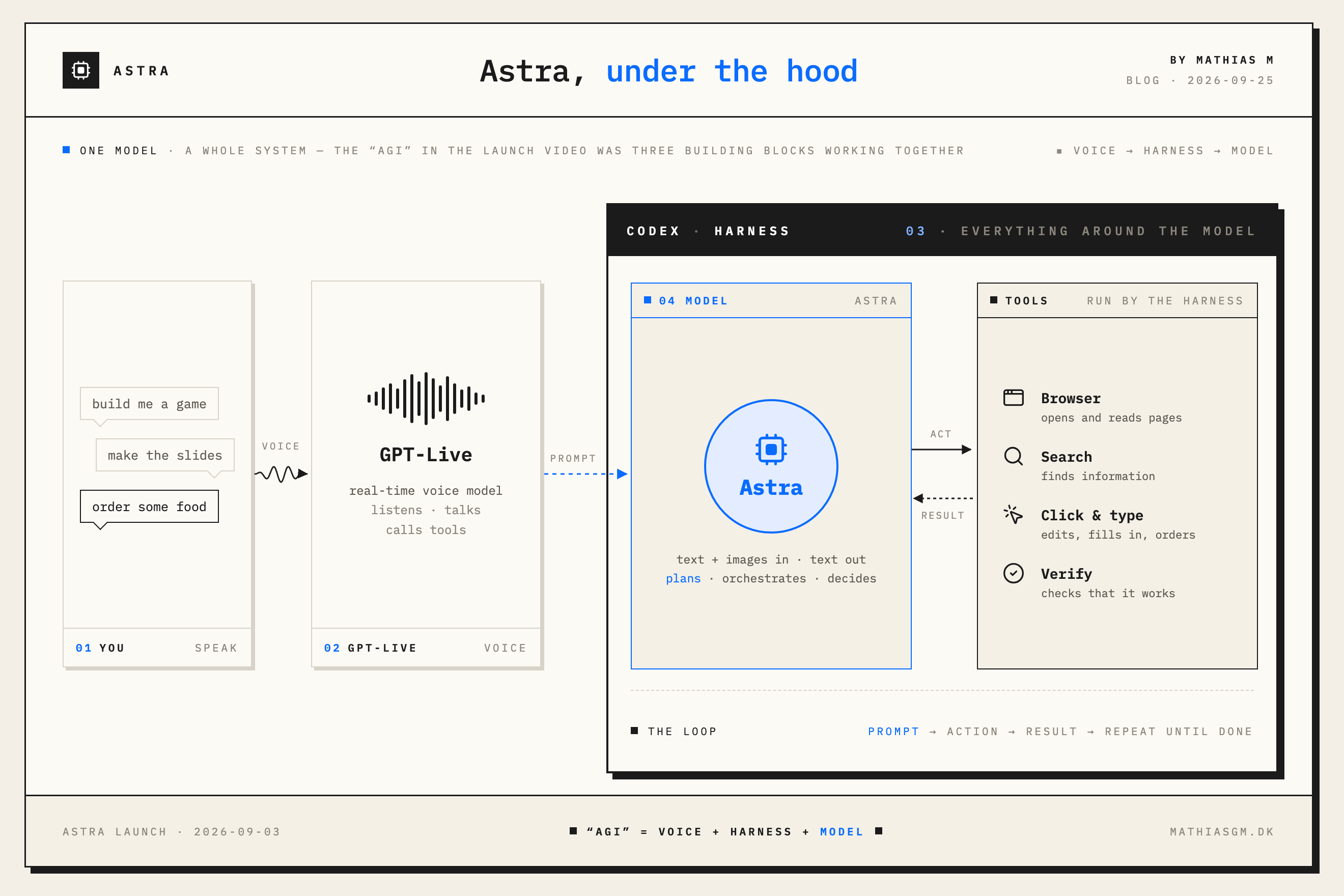
Starting with the audio and voice conversations shown in the video, that was made possible because of OpenAI's new real-time voice model GPT-Live and not Astra. This model is capable of natural conversations in real time, and can do tool calling and interactions during conversations. So what happened in the shown use cases was that the voice model initialised and prompted sessions with Astra inside the Codex harness.
Next, the second impressive part that wasn't Astra itself was the browser interactions shown on the screen. Here people were able to write legal documents and PowerPoint presentations. What happened under the hood was that the harness Codex enabled Astra to interact with the browser, search for information, change text, click buttons, verify it works, order food and so on. Astra orchestrated the work, processed the user input and translated it to actions, which were only possible because of Codex.
Next
What the above shows me is that how we experience intelligence will depend not only on the underlying AI-model, but also on many different sub-components and systems around it. And, as I also ended my last blog on harnesses, I still think there is so much software to be built around AI models and agents in general. Thinking more long term, it is still unclear to me how much of the above can/will be handled by the models, for example if models will 'eat' and learn to handle more and more of what the harnesses do today. For example, how much of this scaffolding is needed if/when the models become multi-modal and process text, images, video, and sound natively, and get significantly larger context windows. Time will tell, but one learning from this post is that right now, with the arrival of Astra, what some people call AGI is not a single model capable of showing artificial general intelligence behavior, but instead a smart AI-model which, together with the right systems around it, can do amazing things.